
 Xiaohongshu
February is the annual month-long celebration of lesbian, gay, bisexual and transgender history. It is a dedicated time to acknowledge, celebrate and share the impact of LGBTQ+ culture.
The theme of 2026 is Science and Innovation which celebrates the contributions of LGBT+ people historically and today, and to raise awareness of the people behind them.
Events
Our event highlights:
LGBTQ+ Community at UCL
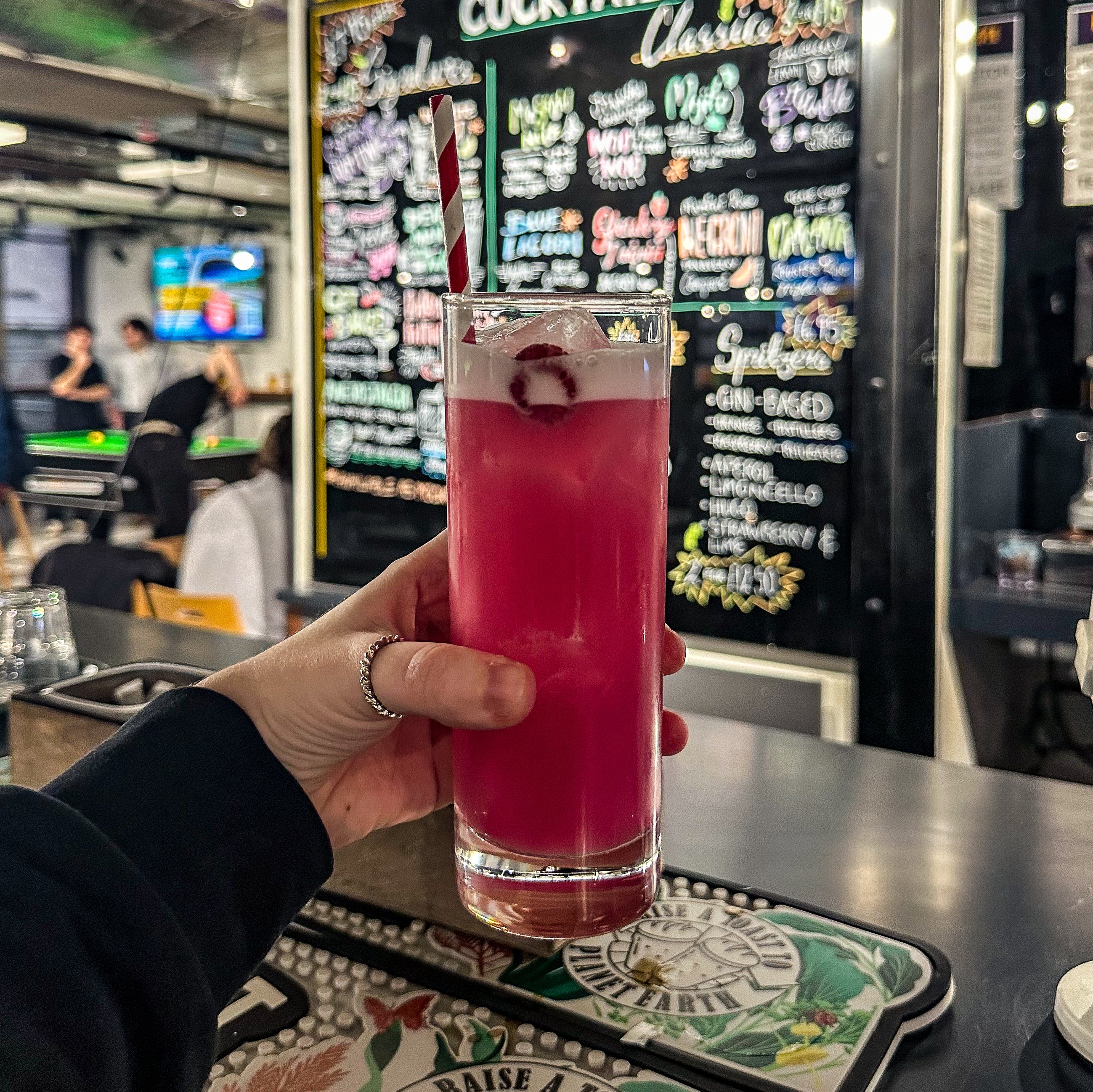
Cocktail of the Month
Celebrate LGBTQ+ History Month with us at the Institute Bar!
Try our special 'La Luchadora' cocktail for just £5, which combines juicy raspberry and tangy lime into a refreshing cocktail. Available only during February, £1 from each sale will be donated to the Gender Expression Fund.
Coinciding with International Festival this LGBTQ+ special cocktail was named in honour of Argentinian philosopher and activist Maria Cristina Lugones.
London-wide Events & Organisations
Meet your Officers
Your LGBTQ+ Officers and Trans Officers lead the Union and their Networks in continuing to build an engaging, dynamic and rewarding community of LGBT+ students on campus and beyond.
Rosanna Pugh, LGBTQ+ Officer
I am Rosanna Steele, your LGBTQ+ officer. I want the LGBTQ+ Network to be a fun, social place for queer students at UCL to find community.
My focus this year has been on supporting queer artists throught the Queer Arts festival, organising engaging events like the Heaven club night and the Queer walking tour. I've also been focusing on trying to start initiatives that support the Trans community such as the Trans Healthcare now project.
I also ensure LGBTQ+ students' interests are represented at policy zones and union events. I'm always open to ideas and suggestions for events and projects so please reach out if you would like to!


Mia Vautier, Trans* Officer
As Trans* Officer Trans* Network I work to increase awareness of several support options offered by UCL for trans students through both online and in-person signposting, as there is extremely little signposting for some methods of support (e.g. free mentoring via gendered intelligence).
Furthermore, alongside the wider UCLSU, I continue to emphasise to UCL that any and all forms of trans hate are unacceptable, and should be dealt with accordingly. Trans students feeling safe at UCL is not a privilege, it is a basic right that ALL students should hold, whether cisgender or transgender.
Community and Support
While being out and proud, it's important to look after your wellbeing. Below are some resources around wellbeing and advice!
TeamUCL
TeamUCL will be offering free TeamUCL Gym passes, and project active classes exclusively for LGBTQ+ and Trans* Students' Network members during LGBT+ History Month!
Equally, the team has developed the Gender Inclusion Hub which offers information and resources on sport and physical activity for students who express a different gender to the one assigned to them at birth. Please visit the page to find out more about:
- Gender Neutral Facilities
- Casual and participation-focused sport
- Sports Clubs
- Representation
Students' Union Advice Service
We are a free, confidential and independent advice and support service. Our trained and experienced team can give you advice about:
- Academic issues - including extenuating circumstances, plagiarism and complaints
- Housing - including contract checks and housemate disputes
- Many other personal and university matters...
You can submit your query through our contact form - please allow 5 working days for us to confirm receipt of your query.
This Month's Must-Reads
Fiction
- Private Rites – Julia Armfield
- Deviants - Santanu Bhattacharya
- Rubyfruit Jungle – Rita Mae Brown
- The Binding - Bridget Collins
- Alice Isn't Dead - Joseph Fink
- The Leather Boys – Gillian Freeman
- The Well of Loneliness - Radclyffe Hall
- Pearl - Siân Hughes
- The House in the Cerulean Sea – T.J. Klune
- Left Hand of Darkness - Ursula K. Le Guin
- Last Night at the Telegraph Club - Malinda Lo
- One Last Stop – Casey McQuinston
- Notes of a Crocodile – Qiu Miaojin
- The Song of Achilles - Madeline Miller
- Detransition, Baby - Torrey Peters
- Atmosphere– Taylor Jenkins Reid
- If We Were Villains – M.L.Rio
- Young Mungo – Douglas Stuart
- The Colour Purple – Alice Walker
- Fingersmith - Sarah Waters
- The Picture of Dorian Grey – Oscar Wilde
- The Safekeep – Yael van der Wouden
- On Earth We’re Briefly Gorgeous – Ocean Vuong
Nonfiction
- None of the above - Travis Alabanza
- Fun Home - Alison Bechdel
- The Transgender Issue - Shon Faye
- The Butch Manual – Clark Henley
- Before we were Trans - Kit Heyam
- The Secret Diaries of Miss Anne Lister- Anne Lister Transcribed by Helena Whitbread
- Desi Queers - Churnjeet Mahn, Rohit K. Dasgupta and DJ Ritu
- Bad Language – So Mayer
- The Queer Thing About Sin – Harry Tanner
- The Log Books – Tash Walker and Adam Zmith
- Daddy Boy – Emmerson Whitney
Fiction Spotlight:

Young Mungo
Douglas Stuart
Growing up in a housing estate in Glasgow, Mungo and James are born under different stars--Mungo a Protestant and James a Catholic--and they should be sworn enemies if they're to be seen as men at all. Yet against all odds, they become best friends as they find a sanctuary in the pigeon dovecote that James has built for his prize racing birds.
As they fall in love, they dream of finding somewhere they belong, while Mungo works hard to hide his true self from all those around him, especially from his big brother Hamish, a local gang leader with a brutal reputation to uphold. And when several months later Mungo's mother sends him on a fishing trip to a loch in Western Scotland with two strange men whose drunken banter belies murky pasts, he will need to summon all his inner strength and courage to try to get back to a place of safety, a place where he and James might still have a future.
The Safekeep
Yael van der Wouden
A house is a precious thing...
It is 1961 and the rural Dutch province of Overijssel is quiet. Bomb craters have been filled, buildings reconstructed, and the war is truly over. Living alone in her late mother’s country home, Isabel knows her life is as it should be—led by routine and discipline. But all is upended when her brother Louis brings his graceless new girlfriend Eva, leaving her at Isabel’s doorstep as a guest, to stay for the season.
Eva is Isabel’s antithesis: she sleeps late, walks loudly through the house, and touches things she shouldn’t. In response, Isabel develops a fury-fueled obsession, and when things start disappearing around the house—a spoon, a knife, a bowl—Isabel’s suspicions begin to spiral. In the sweltering peak of summer, Isabel’s paranoia gives way to infatuation—leading to a discovery that unravels all Isabel has ever known. The war might not be well and truly over after all, and neither Eva—nor the house in which they live—are what they seem.


If We Were Villains
M.L.Rio
Oliver Marks has just served ten years in jail - for a murder he may or may not have committed. On the day he's released, he's greeted by the man who put him in prison. Detective Colborne is retiring, but before he does, he wants to know what really happened a decade ago.
As one of seven young actors studying Shakespeare at an elite arts college, Oliver and his friends play the same roles onstage and off: hero, villain, tyrant, temptress, ingenue, extra. But when the casting changes, and the secondary characters usurp the stars, the plays spill dangerously over into life, and one of them is found dead. The rest face their greatest acting challenge yet: convincing the police, and themselves, that they are blameless.
Nonfiction Spotlight:
The Queer Thing About Sin: Why the West Came to Hate Queer Love
Harry Tanner
In the early days of ancient Greece, queer love was celebrated. The most famous warrior in antiquity loved another man, the poet whose lyrics were memorised by philosophers and kings sang of her desire for women. Men could swear oaths of undying love and live out the rest of their lives together in peace. What fragments survive of this ancient world all tell us one it was not a sin to be queer.
In this extraordinary book, Harry Tanner sets out on a journey to discover the origins of homophobia in the West. He follows the traces of this sinister idea as it swept across the ancient Mediterranean. Wherever he discovers the roots of homophobia taking hold, Tanner finds a confluence of crises mirrored across the centuries. Inequality, fear and an obsession with self-control – this is how societies turn on their queer citizens, time and time again, since the dawn of history.
This is a powerful story that draws on the rich world of the ancients to reveal how homophobia infected Western religion and ideology - the consequences of which we are still living with today - and to that end how we can move forward and resist homophobia in the future.


Desi Queers
Churnjeet Mahn, Rohit K. Dasgupta and DJ Ritu
Desi Queers reveals how diasporic South Asians have shaped LGBTQ+ movements and communities in Britain, from the 1970s to the present day. Weaving the history of 1980s anti-racism with the emergence of Black LGBTQ+ and feminist coalitions, this book highlights landmark moments in British queer life and culture through South Asian lives, and illuminates British histories of colour through queer politics and creativity.
From the Gay Black Group to Haringey Council’s pioneering Lesbian and Gay Unit, desi queers were at the centre of anti-homophobic direct action in the 1980s, including the historic ‘Smash the Backlash’ demo against bigotry. This activism birthed key grassroots groups of the 1980s and 1990s, such as Shakti and Naz, whose founders and early members opened a path of creative resistance to the intersecting violence of racism and homophobia–a path of solidarity echoing through the twenty-first century.
These spaces and networks have been a refuge for people doubly marginalised in Britain–by experiences of homophobia within South Asian communities, and by the whiteness of mainstream queer scenes. Drawing on artistic creations, archives and oral history, Desi Queers celebrates rich traditions of social and cultural activism alongside stories of everyday life among Britain’s LGBTQ+ South Asians.
The Secret Diaries of Miss Anne Lister
Anne Lister, Helena Whitbread
Anne Lister defied the role of womanhood seen in the novels of Jane Austen: she was bold, fiercely independent, a landowner, industrialist, traveler, and a lesbian. She kept extensive diaries of her life and loves, written partly in code. Made up of Greek letters mingled with other symbols of her own devising, Anne referred to the code as her "crypthand," and the use of it allowed her the freedom to describe her intimate life in great detail. Her diaries have been edited by Helena Whitbread, who spent years decoding and transcribing them.
